


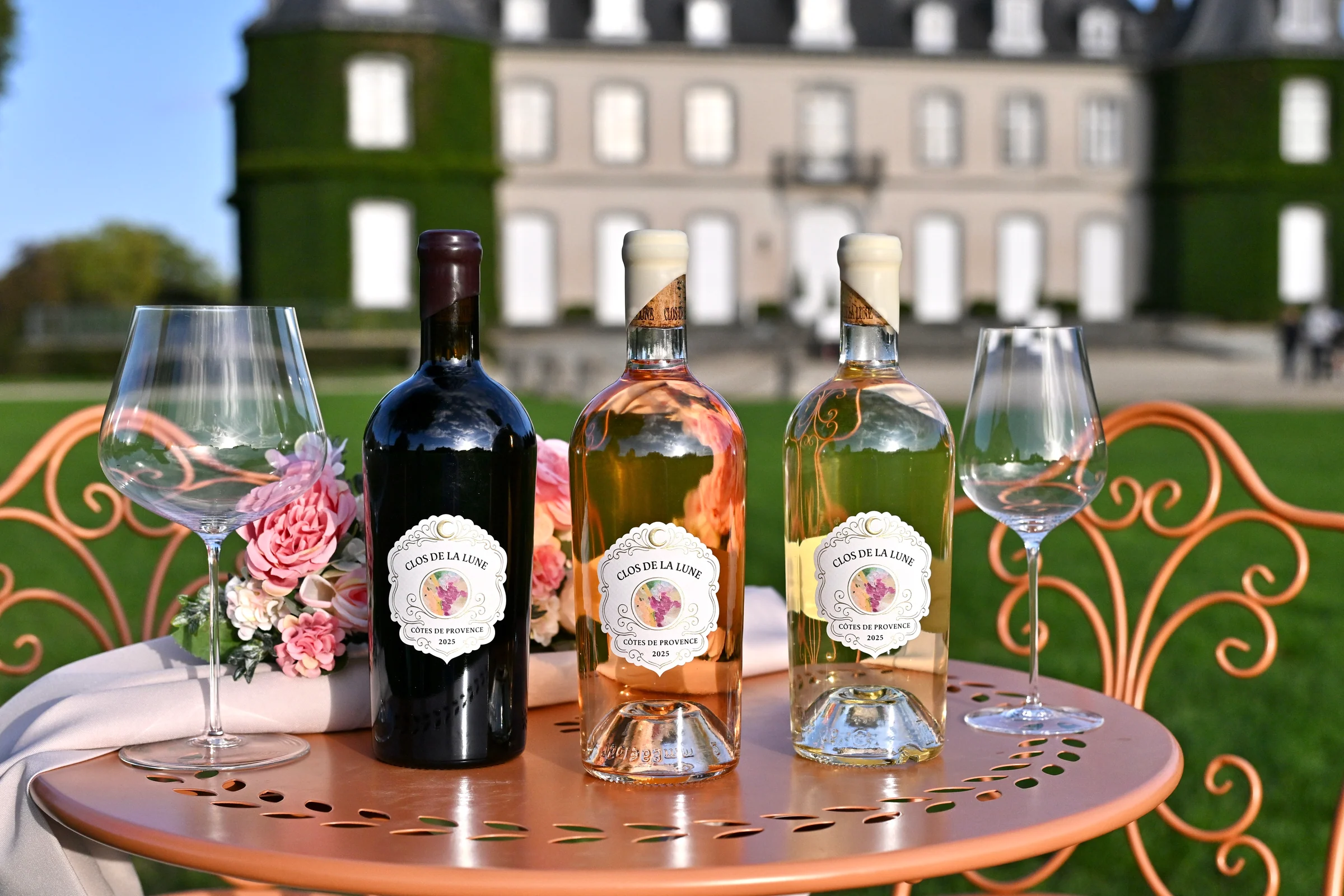
On the heights above Cogolin, La Chêneraie takes its name from the oak woodland surrounding the vines. That is a more tangible origin than the name Clos de la Lune might suggest: selected cuvées adopted the latter in the early 2000s, evoking Provençal nights. The two names do not describe separate estates. They connect one property, its landscape and the bottles made from it at different moments in its history. The 2025 vintage, now presented in white, rosé and red, belongs to that continuity rather than to the sudden arrival of a new house.
From La Chêneraie to three colours
By 2005, Clos de la Lune already had a place in the Guide Hachette. Its editors awarded two stars to the 2003 rosé, made in a run of 10,000 bottles, and situated the vineyard within the Maures landscape, where vines can serve as firebreaks after wildfire. The estate speaks today of a “renaissance” without putting a date to it. The current 2025 collection offers a more tangible point of departure: white, rosé and red share the same name and place, but follow different paths from grape to glass.
Their common ground lies first in the vines on the slopes of the Maures. They grow on schist and granite soils, within a Mediterranean climate moderated by the nearby sea; this is a more specific setting than the familiar image of Provence as a stretch of coast. The vineyard follows organic practices, with the estate emphasising biodiversity and limited intervention. These conditions shape the work, but they do not dictate a wine's flavour on their own: the harvest and the decisions made in the cellar matter too. Vinification takes place in Saint-Tropez, a second location in a story rooted in Cogolin.
Five grape varieties appear in the Clos's account of its vineyard: Cinsault, Grenache, Mourvèdre, Rolle and Syrah. Only four feature in the three 2025 wines discussed here; Mourvèdre is among the varieties cultivated, but not in any of these bottles. Rolle, also known as Vermentino, carries the white on its own and reappears in the rosé; Grenache links rosé and red, where Syrah takes the lead. The proportions make clear how deliberately the estate has differentiated the three wines.
The 2025 white, Rolle without a blend
The 2025 white is not an exercise in blending: it is 100% Rolle, the grape also known as Vermentino. The harvest takes place at night and the grapes are pressed within an hour, before cold settling and fermentation held between 15 and 18°C; three rackings follow, without early filtration. This careful handling leaves room for both fruit definition and breadth. Pomelo, white fruit and a floral touch shape a delicate register, while the rounded palate retains the freshness needed to keep it from feeling heavy.
At the table, we would give it grilled sea bass with gently braised fennel and a light jus lifted by only a little lemon. The fish supplies the substance, fennel a quiet vegetal echo, while the citrus should stay in the background rather than overpower the wine's subtler register. Served at 8–10°C, the white can take a central place in the meal, its roundness as useful to the pairing as its aromatic brightness. A simpler carpaccio of scallops would offer another reading of the same cuvée.
The 2025 rosé: precision behind the colour
The rosé brings together three varieties in a precise balance: 50% Grenache, 40% Cinsault and 10% Rolle. After the night harvest, a very short period of skin contact, around an hour in the press, precedes pressing; the must is then settled cold before fermentation between 15 and 18°C. The method gives the skins little time to mark the wine. Raspberry and fresh strawberry shape its aromatic register, while delicacy, volume and a fresh finish coexist rather than compete. That balance, more than the pale colour, explains why this rosé can hold its place beside a plate.
This is where we would move it beyond the automatic role of aperitif. Grilled langoustines, with saffron aïoli used sparingly, would give the wine a proper course: the shellfish's sweetness answers its fruit, the grill adds depth and a little sauce is enough to enrich the plate without dominating the glass. Roasted Provençal vegetables could follow a similar logic. At 8–10°C the rosé should retain its freshness; served too cold, it risks losing the very nuance the blend was designed to show.
The 2025 red: Syrah without excess
With 75% Syrah and 25% Grenache, the red takes a more assertive direction without making power an end in itself. The two varieties ferment together; pump-overs, initially more frequent, are gradually reduced before the wine is drawn off ahead of the complete end of fermentation. Malolactic fermentation and light filtration complete the work on its texture. In the 2025 wine's documented register, blackberry and gentle spice accompany supple tannins rather than youthful austerity. Its interest lies in that search for proportion: enough substance for a meat course, without extracting so heavily that the fruit disappears.
We would pair it with roast saddle of lamb, black olives and a few sprigs of rosemary, rather than a long, sweetly reduced sauce. Lamb supplies the depth the wine asks for; herbs and olives keep the pairing close to its Mediterranean setting. Concentrated ratatouille or grilled aubergines would give it a meat-free interpretation. Serving temperature matters as much as the plate: at 14–16°C, the red should hold on to its spiced definition, while a warm room would needlessly emphasise the impression of alcohol.
Three wines from one place
Taken together, these 2025 wines deserve more than the usual shortcut of choosing a Provençal bottle by its colour. At our table, the Rolle white would join a fish course, the rosé would have the substance for shellfish, and the Syrah-led red would meet lamb and herbs. That is not a ranking, or even a set menu, but a way to give each cuvée a dish that lets its particular construction matter. The result is a fuller portrait of La Chêneraie: an older property whose name now travels across three wines without erasing their differences.
In Belgium, the Clos's retailer map names La Biosphère in Chaumont-Gistoux, Barbavin in La Hulpe and Caviste Franz Tricot in Charleroi; the estate also directs buyers to Millésima online. It does not welcome visitors to the vineyard. These are listed stockists, not a promise that all three colours and the 2025 vintage will always be available: a call ahead is wiser than an unnecessary journey.
Advertisement — editorial collaboration with Clos de la Lune. Tasting glasses gifted by Zwiesel Glas France.