


In Mareuil-sur-Aÿ, Billecart-Salmon reveals itself in layers: a family history begun in 1818, a precise approach to winemaking, deep cellars governed by patience and, at the heart of the estate, the singular Clos Saint-Hilaire. Experienced in the small-group format favoured by the House, the visit culminates in three prestige vintages bearing the names of its founding family.
A House Best Understood Through Time
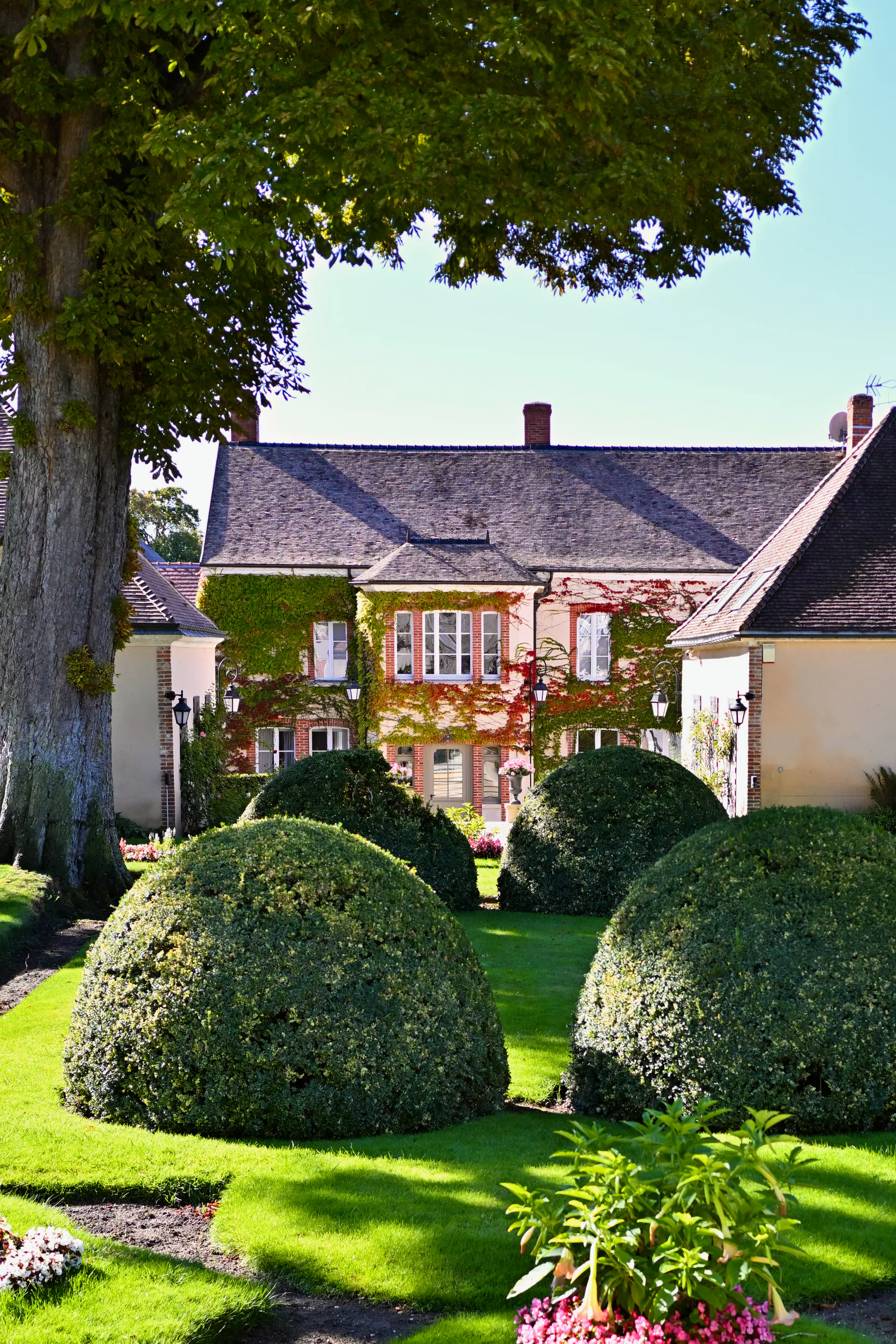
Some Champagne houses are best understood through their labels. Billecart-Salmon is better read as a continuum: a family story, a succession of technical decisions refined across seven generations and an uncommon willingness to let time perform work that no shortcut can replace. Behind the formal garden, the historic house in Mareuil-sur-Aÿ remains both a place of work and the centre of a family legacy.
The same sense of scale shapes the visit. Billecart-Salmon deliberately favours small groups, allowing the itinerary to remain a genuine exchange rather than a procession through a familiar script. From the reception rooms to the winery and then deep underground, the experience is remarkably fluid: complete without becoming demonstrative, generous in what it explains without reducing the House to a catalogue of dates and figures.
Three Names at the Origin of the House
Billecart-Salmon was founded in 1818 through the marriage of Nicolas François Billecart and Elisabeth Salmon. Nicolas François oversaw the commercial development of the new House, while Elisabeth’s brother, Louis Salmon, contributed his knowledge to the making of the wines. More than two centuries later, those three names still define its identity—and reappear on the three cuvées served at the end of the visit.
Now led by Mathieu Roland-Billecart, the seventh generation, alongside Antoine Roland-Billecart, the House remains family-owned and independent: one of the rare historic Champagne houses of its stature to have preserved both. Florent Nys oversees the wines as cellar master, while Denis Blée is responsible for the vineyard and wines. Here, transmission is neither a slogan nor nostalgia; it is a form of governance.
Continuity has never meant immobility. In 1958, Jean Roland-Billecart introduced cold settling and extended fermentation at low temperature, decisions closely associated with the freshness and finesse that became hallmarks of the House. In 1993, François Roland-Billecart withdrew the wines from supermarket distribution to refocus on independent merchants and fine dining. For the bicentenary in 2018, a new cellar equipped with twenty-four 80-hectolitre foudres brought additional precision to parcel-by-parcel work. Each generation has protected the line by refining it.
The Vineyard as the First Measure
Billecart-Salmon owns around 100 hectares of vines and works with fruit from a total area of approximately 300 hectares across forty crus. Most of those vineyards lie within twenty kilometres of Épernay, spanning the Montagne de Reims, the Vallée de la Marne and the Côte des Blancs. The figures matter less as a demonstration of scale than as an explanation of method. They give the cellar team a broad palette of Pinot Noir, Chardonnay and Meunier, but also require each component to retain its identity for as long as possible. Before blending creates the House style, origin must first be understood.
Precision Before Scale
Inside the winery, small temperature-controlled 47-hectolitre tanks allow wines to remain separated by cru and grape variety. Slow fermentation at low temperature belongs to Billecart-Salmon’s long-established approach: an exacting method intended to preserve fruit, freshness and definition rather than impose power. It is a technical choice, but also an editorial one in the truest sense—keeping every origin legible before deciding how it will enter the final composition.
Oak is used with the same sense of proportion. Two barrel cellars hold more than 400 barrels, complemented by the twenty-four foudres installed for the bicentenary. Their purpose is not to give every wine the same signature, but to multiply the possibilities of parcel-by-parcel vinification and choose the most appropriate vessel for each component. The prestige of a blend begins by resisting the urge to blend too soon.
Below Ground, Time Becomes Tangible
The scale of the visit changes in the underground galleries. Here, the House’s most valuable resource is no longer measured in hectares or hectolitres, but in years. Technical precision continues through every stage, including the close inspection of bottles in the cellar. The gesture belongs to the patient sequence of controls that precedes release, when the wine remains beyond the public eye and time is still actively shaping it.
Further into the galleries, rows of bottles make the philosophy physically legible. Long ageing on the lees is not treated as a prestige claim detached from the wine; it is one of the means by which texture, integration and composure are allowed to develop. The exact duration varies by cuvée, but the principle remains constant: release is determined by readiness, not haste.
Walking through these galleries gives the visit its most concrete lesson. Patience, so often invoked abstractly in Champagne, has a physical footprint: darkness, carefully ordered bottles and long periods during which nothing is rushed into visibility. The House’s reserve is not absence of character. It is the confidence to let method speak quietly.
Clos Saint-Hilaire, One Hectare Apart
Within the estate lies one of Billecart-Salmon’s most singular expressions: Clos Saint-Hilaire, a contiguous, enclosed one-hectare parcel adjoining the family property in Mareuil-sur-Aÿ. Its Pinot Noir vines were planted in 1964, and the first vintage of the cuvée was produced in 1995. The Clos takes its name from Saint Hilaire, the patron saint of the village.
The parcel is tended with close attention to soil life, including the reintroduction of horses and sheep. Its scale encourages an almost individual reading of the site: one grape variety, one enclosed vineyard, one vintage. Clos Saint-Hilaire is a single-parcel Blanc de Noirs made entirely from Pinot Noir and vinified in barrel. Produced only in small quantities, in numbered bottles whose total varies with the vintage, it stands apart from the House’s blended cuvées without contradicting them. Where blending seeks harmony across origins, the Clos asks how precisely one place can speak.
Its rarity is a consequence rather than the subject. What matters is the discipline of accepting what one parcel can give in one particular year—and producing no more than that. This refusal to turn scarcity into spectacle may be the clearest expression of the Billecart-Salmon philosophy.
Nearby, bottles from 1961 and 1959 widen the perspective once again. They are more than archival objects: they embody a House capable of thinking beyond the rhythm of a single release and remind us that, in Champagne, transmission concerns wines as much as people. The past is not staged as a museum; it remains part of the working memory of the place.
A Family Portrait in Three Vintages
The visit concludes with three bottles whose names return us to 1818: Elisabeth Salmon Rosé 2013, Nicolas François 2012 and Louis Salmon Blanc de Blancs 2012. Together, they form more than a prestige tasting. They read like a portrait of the founding family, interpreted through three distinct Champagne constructions.
Cuvée Nicolas François 2012 combines 60% Pinot Noir from the Montagne de Reims and Vallée de la Marne with 40% Chardonnay from the Côte des Blancs. Ten per cent of the wines were vinified in oak; the cuvée then spent 120 months on the lees and received a dosage of 3.8 grams per litre. The House summarises its signature as “balance and maturity”—a useful key to a great blend whose proportions, selected crus and measured use of wood have been brought together by a decade of maturation.
Elisabeth Salmon Rosé 2013 brings together 53% Pinot Noir and 47% Chardonnay, all from grands and premiers crus. Less than ten per cent of the Pinot Noir was vinified as red wine from old, south-facing vines in Mareuil-sur-Aÿ, while five per cent of the overall blend was vinified in oak. After 115 months on the lees and a dosage of 4.4 grams per litre, the House defines it through “depth and complexity”: another vision of patience in the demanding architecture of a prestige rosé.
Louis Salmon Blanc de Blancs 2012 turns to Chardonnay alone, from four grands crus of the Côte des Blancs: Mesnil-sur-Oger, Cramant, Chouilly and Oiry. A quarter of the wines were vinified in oak, followed by 115 months on the lees and a dosage of 3.9 grams per litre. “Purity and minerality” are the words chosen by the House. After the blend of Nicolas François and the rosé construction of Elisabeth Salmon, this Blanc de Blancs completes the sequence through a third, sharply defined perspective.
Rather than imposing a catalogue of tasting impressions, the strength of this final flight lies in its structure. Blend, rosé and Blanc de Blancs; Nicolas, Elisabeth and Louis: three vintages that translate one family history into three different expressions of the House. The tasting gathers everything seen beforehand—origin, proportion, vessel and time—into the glass.
What Remains After the Last Glass
Billecart-Salmon’s distinction does not rest on heritage alone. It lies in the way that heritage continues to shape present decisions: small-group hospitality, detailed parcel work, measured use of oak, long cellar ageing and the protection of a one-hectare clos whose production cannot be expanded on demand.
The visit is memorable precisely because it never turns that legacy into theatre. It makes visible a quieter form of luxury—continuity, attention and the freedom to wait. At Billecart-Salmon, time is not the backdrop to the story. It is one of its essential ingredients.
Gastrognito Notebook
Billecart-Salmon is located in Mareuil-sur-Aÿ, in Champagne. Visits are considered on request and confirmed individually; the House deliberately prioritises high-quality hospitality in small groups. Requests can be made no more than three months in advance, and submission does not guarantee confirmation. The available tasting formats and prices are communicated directly by the House after review. Advance planning is therefore essential—and entirely consistent with a place where nothing important is hurried.