


In Reims, Arbane is more than the new home of an accomplished chef. It is the culmination of a career spanning over three decades—the place where Philippe Mille turns everything Champagne has taught him into a deeply personal language: its wines, landscapes, craftspeople, materials and memory. Opened in March 2024, the restaurant earned its first Michelin Star in 2025 and a second in 2026. A rapid ascent, built on a far longer period of maturation.
The moment to become fully oneself
Originally from Sarthe, Philippe Mille’s approach was shaped by a childhood close to the land and by the exacting discipline of France’s great kitchens. After training in Le Mans, he worked at Aubergade, Drouant, Le Pré Catelan, Lasserre and the Ritz, before joining Yannick Alléno at Le Scribe and later Le Meurice. Jean Bordier taught him the foundations of Escoffier, Louis Grondard rigour, Frédéric Anton finesse and Michel Roth the taste for competition. This varied education gave him a firm classical grammar—and the confidence to move beyond it.
A bronze medal at the Bocuse d’Or in 2009, followed by the title of Meilleur Ouvrier de France in 2011, confirmed an already remarkable technical command. In Reims, he took charge of the kitchens at Domaine Les Crayères, earning a first Michelin Star in 2011 and a second in 2012. He remained there for almost fifteen years, gradually making a region he had barely known on arrival the centre of his culinary identity.
Transmission has been another constant. In 2010, Mille created the Trophée Mille for young apprentices in cooking, pastry, service and sommellerie. In his world, the pursuit of excellence is inseparable from the responsibility to pass on the gestures, discipline and confidence that allow a new generation to find its place.
A private house in every sense
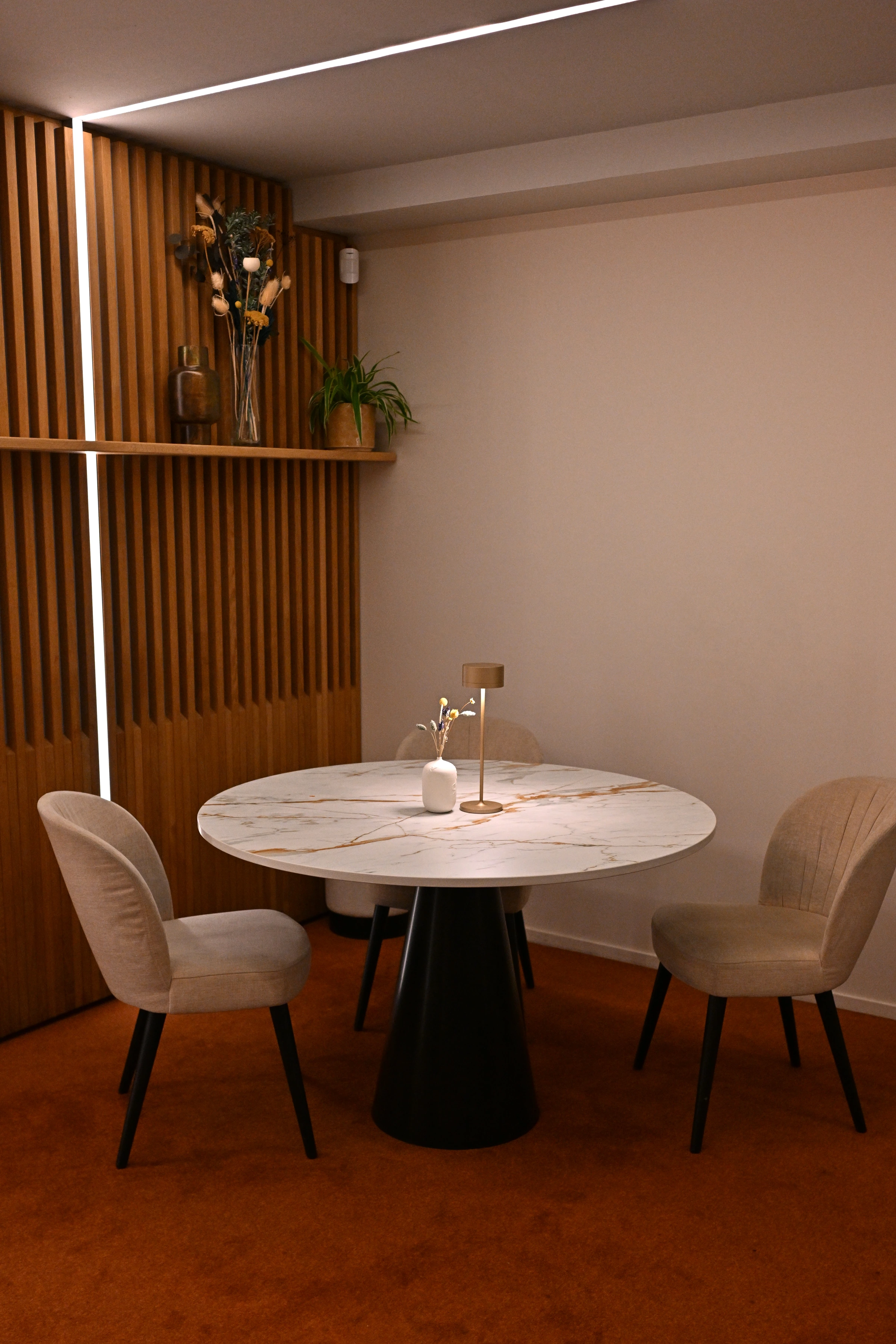
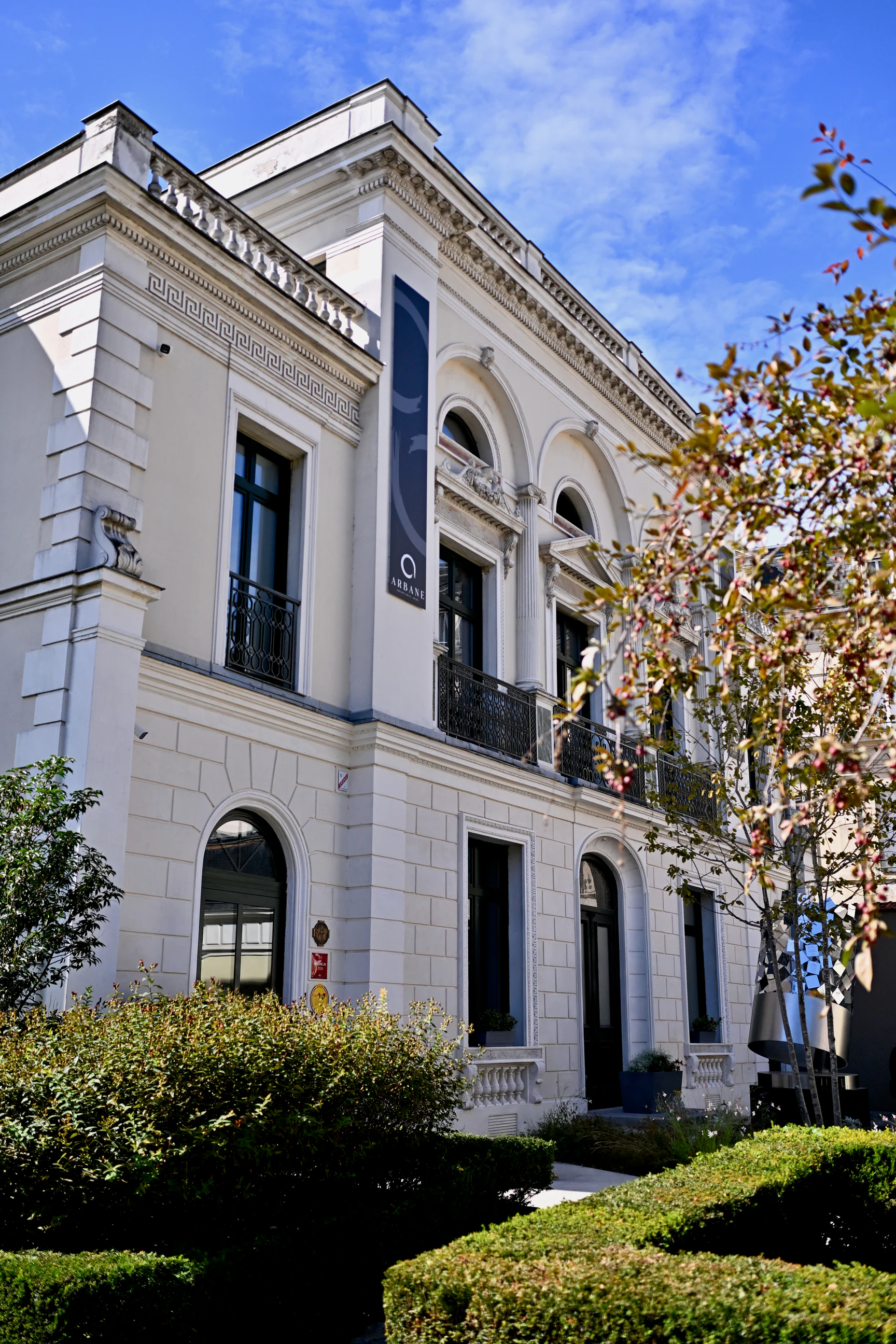
On 29 March 2024, Philippe Mille finally opened an address shaped entirely by his own vision. Arbane occupies a townhouse built in 1874 by the Fortel family at 7 rue Noël. Working with Thomas Architecte, the chef created a two-level experience that begins upstairs in the Salon des Vignes before moving downstairs, between the garden-facing glasshouse and the open kitchen.
Champagne is never reduced to a handful of decorative motifs. Dining tables are covered in plant-based leather made from grapes; some tabletops incorporate crushed and compressed Champagne bottles; cork, chalk, barrel wood and the deep tones of the vineyard establish a continuous material language. Mille favoured regional craftspeople so that each object, from furniture to knife handles, could contribute to the same story.
The result is not a themed interior but an architecture of sensations: a contemporary setting that retains the intimacy of a home and gradually prepares the eye, the ear and the palate for the meal ahead. The kitchen is fully open, not as spectacle, but as the living centre of the room.
Champagne as a raw material
When Philippe Mille first arrived in Reims, Champagne was still, to him, primarily a wine of celebration. Several years of tastings, encounters with growers and observation of the vineyards were needed before he understood it as a fully gastronomic wine. That patient education explains Arbane’s singularity: Mille does not simply cook in Champagne; he now conceives his dishes through it.
The restaurant’s name captures this approach. Arbane is a historic white grape variety of the appellation, long neglected before being rediscovered by a number of growers. Its rarity, character and inherited memory make it a natural emblem for a house intent on revealing the region’s less obvious nuances.
The cooking rests on classical foundations, animated by a contemporary hand. Vine shoots become fuel, barrel staves support certain cooking techniques, green grapes bring tension, and wine-soaked wood extends the conversation between cellar and kitchen. These are not signature effects. They allow the Champagne terroir to act directly upon flavour, smoke, sauces and texture.
The Arbanothèque: a grammar in seven bites
The Arbanothèque® is the emblematic opening of the experience. Through seven bites, Philippe Mille interprets Champagne grape varieties, from the familiar to the discreet. It is not a lesson in ampelography, but a sensory prologue: each creation isolates an energy, texture or aromatic family before the sequence forms its first Champagne landscape.
This introduction says much about the chef’s method. Virtuosity remains legible, the idea precedes the effect, and flavour provides the true narrative thread. In only a few bites, Arbane establishes its vocabulary: vine, vegetation, acidity, woodland, maturity and freshness become elements of a story that continues throughout the meal.
From rose window to barrel stave
Among Philippe Mille’s most personal creations, La Rose, Homage to Notre-Dame de Reims pays tribute to the cathedral’s great rose window. Langoustines marinated in verjus form the centre of a composition punctuated with vegetable mousseline, bisque, herb oil and a lemon condiment. A crisp corn lattice and caviar extend the stained-glass reference without allowing the visual construction to eclipse the act of tasting. It is a signature in the fullest sense: architecture, Champagne and classical precision brought together in one plate.
The Le Millésimé menu, devoted to the restaurant’s signatures, continues this style through deliberately precise titles: Shellfish, Artichoke; Lobster, Courgette Flower; Wagyu Beef, Green Beans. Each pairing seeks clarity rather than accumulation. Michelin has also highlighted the precision of the cooking, the handling of peppers and the restrained use of citrus to preserve freshness.
The lobster is first marked on the grill, then lightly smoked in a half-cask before meeting a stuffed courgette flower and a shellfish emulsion. The technique is present, yet the plate remains immediately intelligible: generosity held in check by freshness, smoke used as punctuation rather than volume.
Fire, wood and wine are never accessories here. They are culinary instruments. A barrel stave can become a cooking surface, vine shoots can sharpen the character of a meat course, and the cellar can suggest the exact acidity a sauce requires. What might elsewhere feel like a catalogue of local references becomes, at Arbane, a coherent method.
One team, several voices
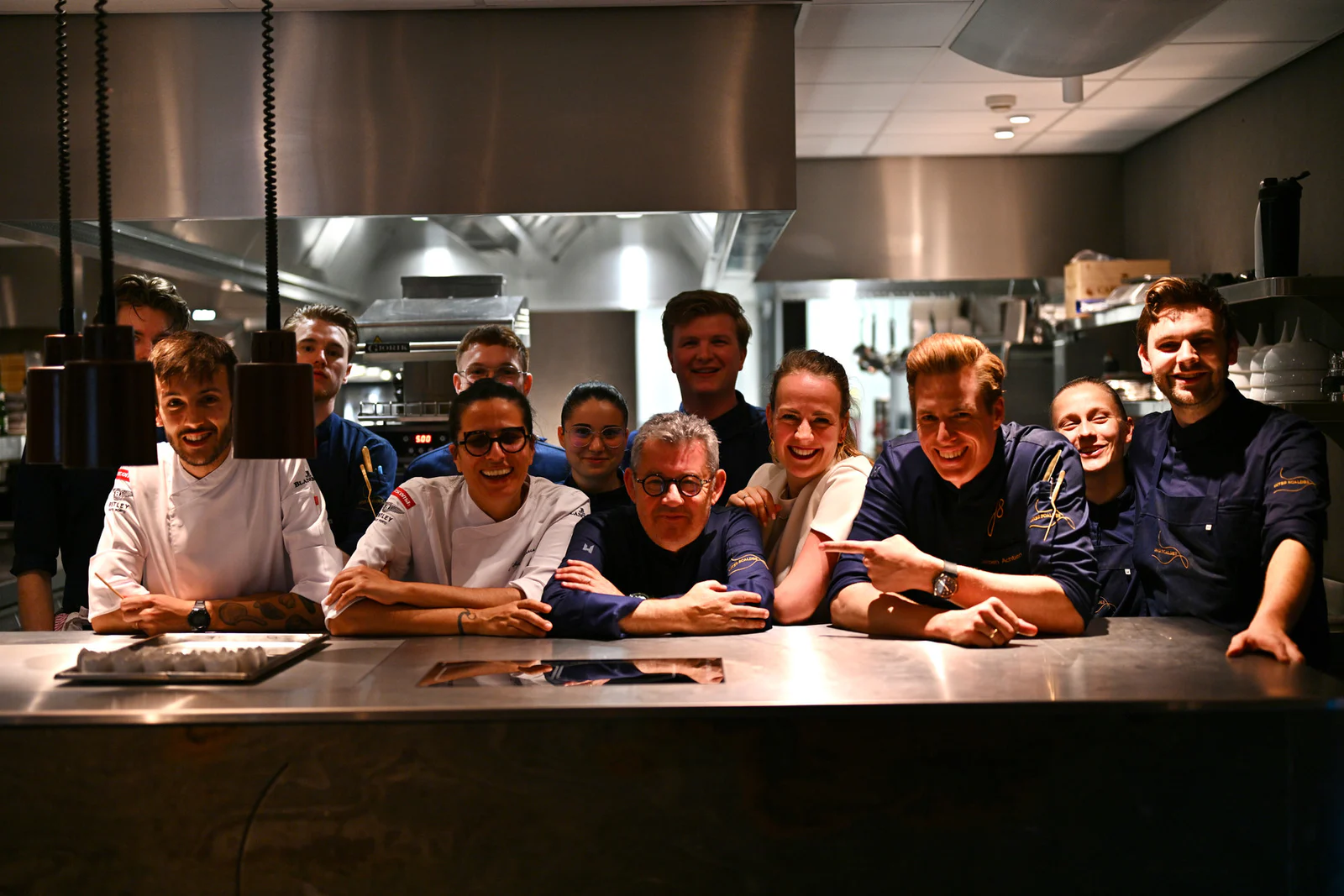
A house this coherent cannot rest solely upon the chef’s hand. Mélanie Arnould leads the dining room after thirteen years at Les Crayères. She approaches hospitality as one would welcome guests into a home: the Salon des Vignes is not simply an antechamber, but a place of transition and conversation where the meal begins before anyone reaches the table.
Head sommelier Valentin Gallais develops an equally vivid interpretation of Champagne. The wine list distinguishes houses from growers, follows the geography of the appellation and also gives space to Coteaux Champenois and ratafia. His work with Mille does not pursue a theoretical perfect pairing, but a conversation capable of altering the perception of both dish and wine. The Pertois-Moriset L’Assemblage poured during our visit offered a particularly lucid expression of that approach.
This complementarity creates service that is precise without becoming ceremonial. The dining room conveys the kitchen’s intentions, the wine programme broadens their reach, and the pacing allows each sequence to retain its clarity. The youth and energy of the team are perceptible, but so is the confidence of a group that already understands the house it is helping to build.
Dessert as the final chapter
The sweet repertoire is entrusted to pastry chef Arnaud Beck, who has been part of Arbane since it opened. In 2026, Michelin awarded him the Passion Dessert distinction and included his Strawberries from Vertus among its inspectors’ ten favourite desserts. The recognition highlights restaurant pastry conceived as a continuation of the meal: seasonal, articulate and guided by balance rather than display alone.
The current menus conclude in particular with À l’Origine, whose seasonal expression brings together strawberry, rhubarb and peach. The name captures the house’s intention: begin with the fruit and its maturity, then build around it without erasing its identity. The fruit-led transition served before the final dessert follows the same logic—precision first, sweetness kept in perspective.
Two Stars—and, above all, a house
A first Star in 2025, a second in 2026 and a score of 17/20 from Gault&Millau: within two years, Arbane established itself among Reims’ leading tables. Yet reducing its achievement to speed would miss the point. The restaurant condenses several decades of craft, fifteen years of immersion in Champagne and a long-deferred desire to write without institutional constraints.
What remains after Arbane is the rare unity of the experience. The setting, cuisine, cellar, craftsmanship and service never tell competing stories. They speak of the same Champagne—alive, precise and contemporary—and of a chef who, after serving great houses for many years, has finally found his own.